From Stone to Script
The journey of the Hebrew alphabet from ancient pictographs carved in stone to the script used in Torah scrolls today.
How the alphabet of Abraham, Moses, and David became the Hebrew we read today
Paleo-Hebrew, circa 1000 BC
𐤁𐤓𐤀𐤔𐤉𐤕 𐤁𐤓𐤀 𐤀𐤋𐤄𐤉𐤌 𐤀𐤕 𐤄𐤔𐤌𐤉𐤌 𐤅𐤀𐤕 𐤄𐤀𐤓𐤑
Modern Hebrew (Square Script), used today
בְּרֵאשִׁית בָּרָא אֱלֹהִים אֵת הַשָּׁמַיִם וְאֵת הָאָרֶץ
Most people assume the Hebrew alphabet has always looked the way it does today. It hasn't.
The square letters found in modern Torah scrolls and Israeli street signs are actually an Aramaic-influenced script adopted centuries after the time of Moses and David.
The original Hebrew script, known as Paleo-Hebrew, was a pictographic alphabet where each letter began as a simple picture representing an everyday object. Understanding this journey transforms how we read and appreciate the Scriptures.
Where would you like to start?
The Story of the Script
A 3,000-year journey from pictographs scratched in stone to the printed letters of a modern nation.
Proto-Sinaitic Origins
The earliest ancestor of the Hebrew alphabet emerged in the Sinai Peninsula, likely developed by Semitic-speaking workers influenced by Egyptian hieroglyphics. These simple pictographs worked on a clever principle: the picture of an ox head made the “ah” sound because the word for ox (“aleph”) started with that sound. Each letter was named after the picture it resembled, and the first sound of that name became the letter’s sound. Linguists call this principle “acrophony” (a fancy way of saying “the picture’s name gives you the sound”).
Early Paleo-Hebrew
As the Israelites settled in Canaan, the script standardized into what scholars call Paleo-Hebrew. This is the script of the early judges and kings period. The Gezer Calendar (~925 BC) is one of the oldest known examples.
The First Temple Period
Paleo-Hebrew was the everyday and official script during the united and divided monarchy. Artifacts like the Siloam Inscription (carved during King Hezekiah’s reign, ~700 BC) and the Lachish Letters show this script in active use. This is the script David and Solomon would have known.
The Babylonian Exile
When Judah fell to Babylon, the Jewish people were immersed in Aramaic language and culture. Over time, they adopted the Aramaic square script for writing Hebrew. This was not a change in language, only a change in the letters used to write it. Think of it like switching from cursive to print: same words, different shapes.
The Second Temple Transition
During the Second Temple period, the square Aramaic-style script (sometimes called “Ashuri,” meaning “Assyrian,” because of its origins in that region) gradually replaced Paleo-Hebrew for most uses. The Dead Sea Scrolls provide fascinating evidence of this transition: some scrolls use the older Paleo-Hebrew specifically when writing the divine name YHWH, as if the scribes felt the ancient letters were more fitting for God’s name.
Bar Kokhba Revival
During the Bar Kokhba revolt against Rome, Paleo-Hebrew was briefly revived on coins as a symbol of Jewish national identity and independence, connecting the rebellion to the glory days of ancient Israel.
Modern Revival
Eliezer Ben-Yehuda’s revival of Hebrew as a spoken language used the square Ashuri script, which had been standard for over 2,000 years. This is the script used in Israel today.
The 22 Letters Side by Side
Every letter of the Hebrew alphabet traces back to an ancient pictograph. Here they are, old and new, with the picture that started it all.
Letters 1–6
 א
אAleph
Ox head (strength, leader)
 ב
בBet
House, tent
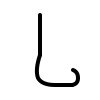 ג
גGimel
Camel, foot (to carry, walk)
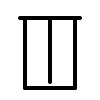 ד
דDalet
Door
 ה
הHey
Man with arms raised (behold, look)
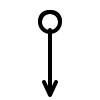 ו
וVav
Tent peg, hook (to secure, connect)
Letters 7–12
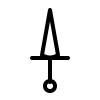 ז
זZayin
Weapon, plow (to cut, nourish)
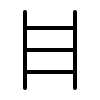 ח
חChet
Fence, enclosure (to protect, separate)
 ט
טTet
Snake, basket (to surround)
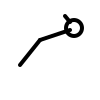 י
יYod
Hand, arm (to work, deed)
 כ / ך
כ / ךKaf
Open palm (to cover, allow)
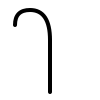 ל
לLamed
Shepherd’s staff, goad (to teach, guide)
Letters 13–17
 מ / ם
מ / םMem
Water, waves (chaos, mighty)
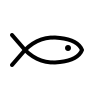 נ / ן
נ / ןNun
Seed, fish, sprout (to continue, heir)
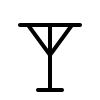 ס
סSamekh
Support, thorn (to protect, support)
 ע
עAyin
Eye (to see, know, experience)
 פ / ף
פ / ףPey
Mouth (to speak, word)
Letters 18–22
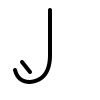 צ / ץ
צ / ץTsade
Fishhook, man on side (to hunt, righteous)
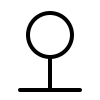 ק
קQof
Back of the head, sun on horizon (cycle)
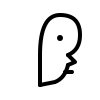 ר
רResh
Head of a person (chief, beginning)
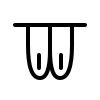 ש
שShin
Teeth (to consume, destroy, sharp)
 ת
תTav
Crossed sticks, mark, sign (covenant, seal)
Watching the Letters Transform
The Paleo-Hebrew pictographs didn't become modern square letters overnight. The transformation happened gradually over centuries as scribes simplified, rotated, and abstracted the original pictures. Here you can trace each letter's journey through four key stages.
Aleph
Bet
Dalet
Hey
Vav
Yod
Mem
Ayin
Pey
Shin
Tav
The remaining letters (Gimel, Zayin, Chet, Tet, Kaf, Lamed, Nun, Samekh, Tsade, Qof, and Resh) follow similar patterns of gradual simplification and abstraction.
From Aleph to Alphabet
How Ancient Hebrew Letters Became the ABCs
Here is something most people never realize: the English alphabet you are reading right now descends from the same ancient Semitic pictographs that became the Hebrew alphabet.
When Phoenician traders carried their script across the Mediterranean, the Greeks adopted it, flipped and renamed the letters, and passed it on to the Romans, who gave it to us. The journey from Aleph to Alpha to the letter A is one continuous story.
Aleph → Alpha → A
Mem → Mu → M
Ayin → Omicron → O
Shin → Sigma → S
| Paleo | Hebrew Name | Greek | Greek Name | English |
|---|---|---|---|---|
| 𐤀 | Aleph | Α | Alpha | A |
| 𐤁 | Bet | Β | Beta | B |
| 𐤂 | Gimel | Γ | Gamma | G (and C) |
| 𐤃 | Dalet | Δ | Delta | D |
| 𐤄 | Hey | Ε | Epsilon | E |
| 𐤅 | Vav | Υ | Upsilon | F, U, V, W, Y |
| 𐤆 | Zayin | Ζ | Zeta | Z |
| 𐤇 | Chet | Η | Eta | H |
| 𐤉 | Yod | Ι | Iota | I, J |
| 𐤊 | Kaf | Κ | Kappa | K |
| 𐤋 | Lamed | Λ | Lambda | L |
| 𐤌 | Mem | Μ | Mu | M |
| 𐤍 | Nun | Ν | Nu | N |
| 𐤏 | Ayin | Ο | Omicron | O |
| 𐤐 | Pey | Π | Pi | P |
| 𐤓 | Resh | Ρ | Rho | R |
| 𐤔 | Shin | Σ | Sigma | S |
| 𐤕 | Tav | Τ | Tau | T |
The word “alphabet” itself comes from the first two Hebrew/Greek letters: Alpha + Beta, or in the original Hebrew, Aleph + Bet.
Every time you recite your ABCs, you are echoing an ancient Semitic tradition that stretches back nearly 4,000 years. The next time you write the letter A, remember that you are drawing a simplified, rotated ox head, and that the same pictograph lives on in the Hebrew letter Aleph. Scripture's language has shaped not just faith, but the very letters of human civilization.
Why This Matters for Understanding Scripture
When we understand that each Hebrew letter originally carried a visual meaning, it can add a layer of richness to our study of God's Word. While we should be careful not to build theology on pictographic interpretations alone, the connections are often beautiful and worth reflecting on.
Father (Av)
Letters: Aleph (ox/strength) + Bet (house)
Pictographic reading: “Strength of the house”
The father is the strong one of the household, the protector and provider. This meaning resonates throughout Scripture’s portrayal of both earthly fathers and God as our heavenly Father.
Son (Ben)
Letters: Bet (house) + Nun (seed/continue)
Pictographic reading: “The one who continues the house”
A son carries forward the family line and the household name. Consider how Yeshua (Jesus), the Son, continues and fulfills the house of David and the household of God.
The Name of God (YHWH)
Letters: Yod (hand) + Hey (behold) + Vav (nail/peg) + Hey (behold)
Pictographic reading: “Behold the hand, behold the nail”
Many believers see a profound foreshadowing of the crucifixion in these pictographs. While this is a devotional observation rather than a linguistic argument, it invites us to marvel at the depth woven into God’s revealed name.
Truth (Emet)
Letters: Aleph (ox/first) + Mem (water/chaos) + Tav (mark/sign)
Pictographic reading: “The first and last sign”
Emet is spelled with the first letter (Aleph), the middle letter (Mem), and the last letter (Tav) of the Hebrew alphabet, spanning from beginning to end. Jesus declared, “I am the way, the truth, and the life” (John 14:6).
Covenant (Brit)
Letters: Bet (house) + Resh (head/person) + Yod (hand) + Tav (sign/cross)
Pictographic reading: “The house of a person, by hand, marked with a sign”
Covenant in the ancient world was deeply personal. It was sealed by a mark or sign, made by hand. God’s covenants with His people have always been personal and sealed with a sign, from the rainbow to the cross.
A note on pictographic word studies:
These reflections are devotional in nature. While the pictographic origins of Hebrew letters are well-established by archaeology, building word meanings from individual letter pictures is not the same as formal Hebrew linguistics. The ancient pictographs predate the words that were later spelled with these letters. Enjoy these connections as a source of wonder and worship, but always ground your theology in the full context of Scripture and careful Bible study.
Written in Stone: The Evidence
These real archaeological discoveries confirm the history of the Hebrew script. Each artifact is a tangible connection to the world of the Bible.
The Gezer Calendar
Script: Paleo-Hebrew
A small limestone tablet listing agricultural seasons in Paleo-Hebrew. One of the oldest known examples of Hebrew writing. Some scholars believe it was a schoolboy’s writing exercise.
The Siloam Inscription
Script: Paleo-Hebrew
Carved in Paleo-Hebrew, it describes the dramatic moment when two teams of miners digging from opposite ends met in the middle. It provides direct evidence of the engineering project described in 2 Kings 20:20 and 2 Chronicles 32:30.
The Lachish Letters
Script: Paleo-Hebrew
A collection of letters written in Paleo-Hebrew on pottery shards (broken pieces of clay pots that ancient people used like notepaper). Written during the final days before the Babylonian destruction of Judah, they provide a firsthand witness to the desperate conditions described by the prophet Jeremiah.
The Moabite Stone (Mesha Stele)
Script: Moabite (closely related to Paleo-Hebrew)
A large inscribed stone monument (a “stele” is simply an upright stone slab with writing carved into it). It describes events from the perspective of King Mesha of Moab, who is mentioned in 2 Kings 3. It uses a nearly identical script to Paleo-Hebrew, showing how widespread this alphabet family was.
The Dead Sea Scrolls
Script: Mixed (Square and Paleo-Hebrew)
These scrolls demonstrate the transition period between scripts. Most are written in the Aramaic square script, but several use Paleo-Hebrew for the divine name YHWH, and a few texts (like the Paleo-Hebrew Leviticus scroll) are written entirely in the older script.
Bar Kokhba Coins
Script: Paleo-Hebrew
Minted during the Jewish revolt against Rome. These coins deliberately used Paleo-Hebrew script as a nationalistic statement, connecting the rebellion to the ancient Israelite past, even though the square script had been standard for centuries.
What Most People Get Wrong
Separating fact from fiction about the Hebrew alphabet.
?Misconception“Modern Hebrew letters are the same ones Moses used.”
Reality
Moses would have written in Paleo-Hebrew (or an even earlier version of the script that scholars call “proto-Sinaitic,” meaning “from the Sinai region”). The square letters used today were adopted from Aramaic during and after the Babylonian Exile, roughly 1,000 years after Moses.
?Misconception“Paleo-Hebrew is a different language from Modern Hebrew.”
Reality
Paleo-Hebrew and Modern Hebrew use different scripts (alphabets), but the underlying language is the same, just as English can be written in print or cursive without changing the language itself. Think of it like the difference between typing and handwriting.
?Misconception“The square script was invented by the Jewish people.”
Reality
The square script (called “Ashuri,” meaning “Assyrian,” because of its regional origins) was borrowed from the Aramaic alphabet. Aramaic was the common language of business and government in the Babylonian and Persian empires. Jewish scribes adopted these Aramaic-style letters and used them to write Hebrew.
?Misconception“We can build theology by decoding the pictographic meaning of each letter in a Hebrew word.”
Reality
While the pictographic origins of each letter are well-documented, words developed their meanings through usage in context, not by combining letter pictures. Pictographic letter studies can be a beautiful devotional exercise, but they should complement, not replace, careful study of grammar, syntax, and context.
?Misconception“Paleo-Hebrew disappeared completely.”
Reality
Paleo-Hebrew lingered for centuries after the square script became dominant. It was used on coins, in some Dead Sea Scroll texts, and by the Samaritans, whose community still uses a script descended from Paleo-Hebrew to this day.
This page presents well-established scholarship about the history of the Hebrew alphabet. Pictographic letter data is based on Proto-Sinaitic and early Phoenician forms documented by researchers including Frank Moore Cross and Christopher Rollston.